Symposium
NSS Americas
NSF Europe
NSS Japan
NSS SE Asia
NSS Korea
Archive
Magazine
Current Issue
Archive
On-Demand
About
Subscribe
Symposium
NSS Americas
NSF Europe
NSS Japan
NSS SE Asia
NSS Korea
Archive
Magazine
Current Issue
Archive
On-Demand
About
Subscribe
×
Magazine
Current Issue
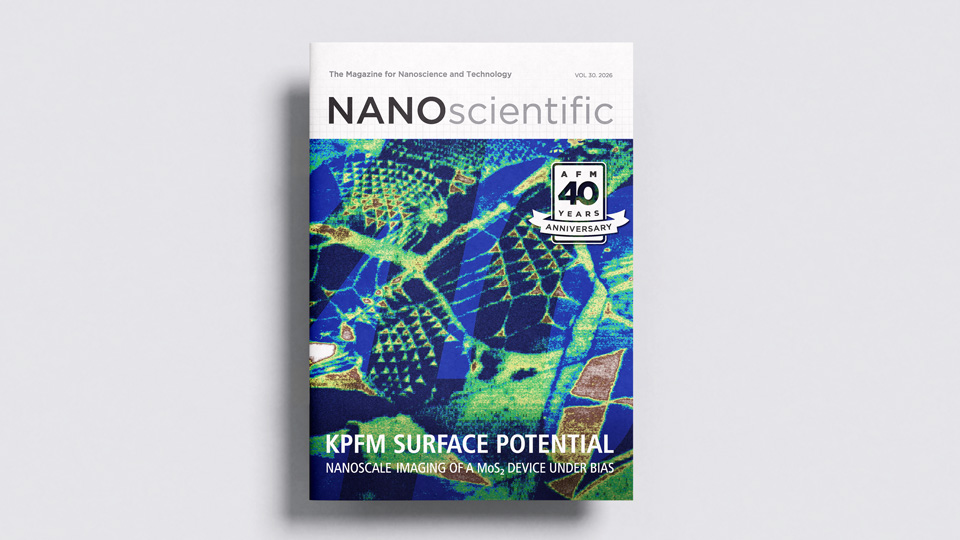
Volume 30 | 21 May 2026
NANOscientific Magazine, 2026
Download PDF
Subscribe
Nanotechnology
From Non-Contact AFM to Functional Nanoscopy Expanding the Capabilities of Scanning Probe Microscopy
Over the past four decades, atomic force microscopy has evolved from a surface imaging tool into a versatile platform for nanoscale characterization. Beyond topography, AFM now enables measurement of electrical, magnetic, thermal, and optical properties with high spatial resolution. This transformation was driven by the need to understand functionality at the nanoscale, particularly in semiconductor manufacturing and advanced materials research.
21 May 2026
Nanotechnology
The Bold Pivot: an Interview with John Foster on Calvin Quate and the Birth of AFM, Forty Years After AFM – A Personal Reflection from the Stanford Lab
In 1986, the atomic force microscope (AFM) was introduced to the scientific community, transforming our ability to explore the nanoscale. At the center of that breakthrough was Calvin F. Quate, whose bold leadership at Stanford University reshaped the trajectory of scanning probe microscopy.By the early 1980s, Quate’s laboratory was already internationally recognized for pioneering acoustic microscopy.
20 May 2026
Nanotechnology
From Laboratory Curiosity to Industrial Infrastructure: The Commercial Evolution of AFM — A Founder’s Perspective on Building Park Systems and Industrializing Atomic Force Microscopy
In the early 1980s, as scanning tunneling microscopy (STM) began revealing atomic images of silicon surfaces, a quiet revolution was taking shape at Stanford University. Under the leadership of Calvin Quate, researchers were pushing beyond the limits of optical microscopy and redefining what it meant to “see” matter.Achieving atomic resolution was not routine—it demanded patience, precision, and sometimes luck. For those who succeeded, it felt like entry into an exclusive club.
20 May 2026
Nanotechnology
Electrical AFM Characterization of Devices Using an Integrated Multi-Probe Platform
As research on next-generation semiconductor devices and two-dimensional (2D) materials continues to accelerate, there is growing demand for measurement platforms capable of probing both electrical behavior and nanoscale surface properties simultaneously. Atomic force microscopy (AFM) has long been an essential tool for nanoscale characterization, providing high-resolution imaging alongside electrical and mechanical measurements¹˒². However, advanced electrical AFM techniques—such as Kelvin probe force micr
19 May 2026
Nanotechnology
Deciphering Electrical Bistability In Nanocomposite Devices Using Electrostatic Force Microscopy
The search for new electronic memory technologies remains one of the central challenges in modern electronics. As computing systems demand faster processing speeds, higher data density, and reduced power consumption, researchers continue to explore materials and device architectures capable of storing information in fundamentally different ways.
19 May 2026
Nanotechnology
Active AFM Cantilevers And The New Research They Enable
Since its introduction in 1986, the atomic force microscope (AFM) has evolved largely through advances in cantilever design and microfabrication. Early progress was driven by miniaturization, making cantilevers smaller, faster, and more precise. This strategy dramatically increased imaging speed and force sensitivity, enabling high-speed AFM and expanding the technique into liquid environments and dynamic biological systems.
19 May 2026
Manufacturing
Electrical & Electronics
Nanotechnology
Scanning Probe Magnetic Microscopy with Magnetoresistive Magnetic Sensors
Magnetic imaging at the micro- and nanoscale is an essential tool for investigating magnetic phenomena in materials science, condensed matter physics, and nanotechnology.
19 May 2026
Manufacturing
Nanotechnology
Nanoscale Dynamic Mechanical Analysis with AFM at Sub-Zero Temperatures
Dynamic Mechanical Analysis (DMA) is one of the most widely used techniques for characterizing the viscoelastic behavior of polymers and elastomers. By measuring the mechanical response of a material under oscillatory loading, DMA provides critical inform
18 May 2026
Programs & Resources
Everything You Need to Advance Your Research
NANOscientific On-Demand
Access recorded presentations from all NSS symposiums, organized by topic.
Learn More →
Knowledge Center
Learn from AFM experts through online courses designed for convenient, practical learning.
Learn More →
AFM Scholarship
Empower the next generation of nanoscience researchers through scholarships and open scientific exchange.
Learn More →