An Interview with Prof. Franz Giessibl, University of Regensburg, Germany
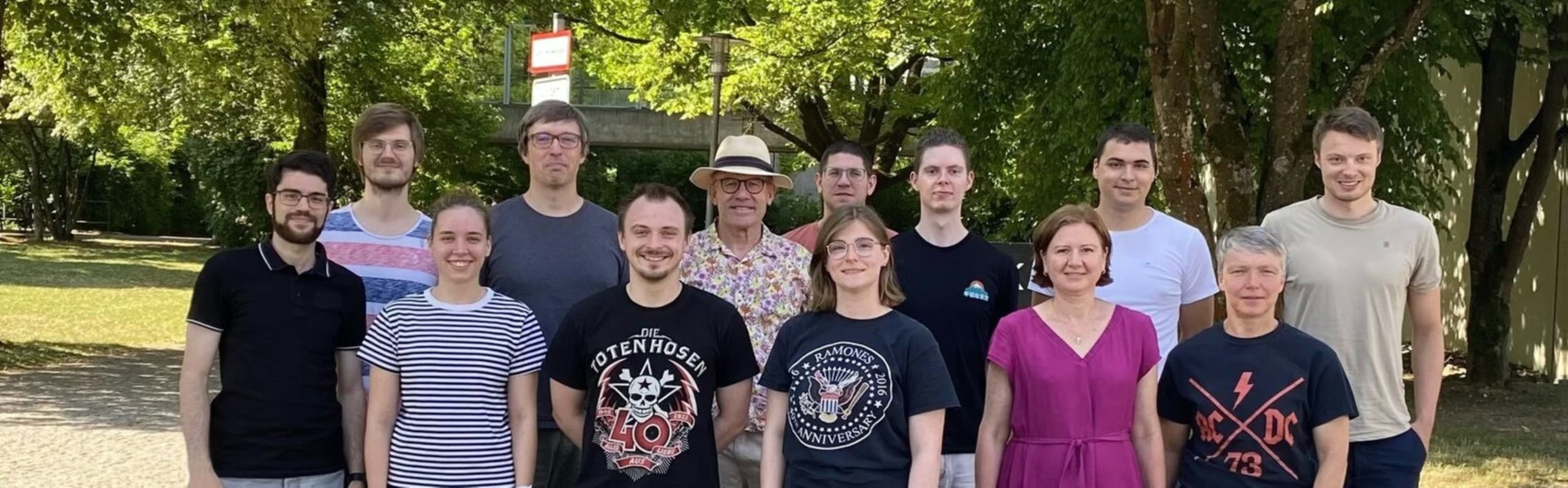
Prof. Franz Giessibl (center, wearing a hat) with his research team
Few researchers have shaped the field of atomic force microscopy as profoundly as Prof. Franz Giessibl. From his early work with Nobel laureate Gerd Binnig during the formative years of AFM to the invention of the qPlus sensor that transformed high-resolution force microscopy, Giessibl has remained at the forefront of atomic-scale imaging for more than three decades. In this interview with NanoScientific, he reflects on the evolution of AFM, the pursuit of practical atomic-resolution imaging under ambient conditions, the challenges that still remain, and the future directions of next-generation nanometrology. He also discusses how advances in instrumentation, accessibility, and emerging technologies such as AI may shape the next era of AFM research.
NS: Looking back, what first drew you to AFM and atomic-scale measurements?
Giessibl: My research focuses on atomic force microscopy (AFM), and I have been working in this field for most of my career. I began in 1986, during my time as an exchange student at ETH Zurich. I heard about a nearby lab where a microscope capable of imaging atoms had been developed, which immediately captured my interest.
I applied for an internship at IBM Research in Rüschlikon, where I initially worked in optics. On my last day, my supervisor told me that Gerd Binnig—who would soon share a Nobel Prize with his colleague Heinrich Rohrer for their invention of the scanning tunneling microscope— was returning to Europe to establish a research group in Munich. I was asked whether I would be interested in joining him as a PhD student.
A few months later, Binnig personally called me and offered three possible research projects: building a tunneling sensor to detect gravitational waves, sequencing DNA using STM, or improving AFM to achieve true atomic resolution. At the time, AFM had been invented (1986), but it had not yet demonstrated true atomic resolution. I chose that challenge for my PhD.
NS: How did your early experience developing commercial AFM systems influence your later research?
Giessibl: Toward the end of my PhD, we were already using cantilevers from Calvin Quate’s group at Stanford. Around that time, Park Scientific Instruments—the predecessor of Park Systems—had just been founded. Sang-il Park, who had worked with Quate, began commercializing STM systems and later recognized the importance of AFM.
I joined Park Scientific Instruments to develop a vacuum AFM. With the AutoProbe VP, we achieved atomic resolution on silicon using AFM for the first time. At that point, I thought many of the fundamental challenges in AFM had been solved.
I then left academia to become a management consultant at McKinsey. However, during that time, I serendipitously invented a new concept for a force sensor—the qPlus sensor—which led me back into academic research.
NS: What research principles were most important in advancing practical atomic-resolution AFM?
Giessibl: Our primary focus has always been achieving the highest possible spatial resolution. That means minimizing noise and maximizing sensitivity to extremely small forces.
We have achieved sub-ångström lateral resolution and height resolution down to about 400 femtometers (0.4 picometers). This pursuit of precision has shaped the design philosophy of our instruments.
The qPlus sensor, which I developed, is now widely used in low-temperature AFM systems. While it had not been widely applied in ambient conditions, we demonstrated in our lab that true atomic resolution is possible under ambient conditions using this approach. The NX1 represents an effort to bring this capability into a commercial system.
NS: What is most important when turning laboratory AFM concepts into reliable research instruments?
Giessibl: What I appreciated most was the ability of Park Systems to take laboratory concepts and implement them in a robust, practical way.
For example, in early systems, wiring was often a major source of failure. In our lab instruments, wires frequently broke. Park addressed this with professional engineering solutions for signal routing and system integration. These may seem like small details, but they are critical for reliability.
NS: What limitations of existing AFM systems led to the development of the NX1?
Giessibl: One major limitation was the lack of integration between high-resolution AFM and optical microscopy. Our lab-built systems lacked a good optical interface.
Another issue was sample positioning. We used relatively crude mechanical systems, whereas the NX1 incorporates inertial drives for precise X–Y positioning, which is especially useful for locating features like graphene flakes.
NS: What are the key requirements for stable atomic-resolution imaging?
Giessibl: The most important factors are:
- Mechanical rigidity
- Thermal stability (low drift)
- Sensitive force detection
- Well-defined probe tips
For thermal stability, materials such as Kovar are used due to their low thermal expansion. Mechanical rigidity ensures that the tip–sample distance remains stable.
At low temperatures, we often use a CO molecule at the tip apex, which provides extremely high spatial resolution due to its small size and chemical inertness. A major challenge is finding an equivalent probe for ambient conditions.
NS: How do features like low noise and qPlus sensing improve atomic-scale measurements?
Giessibl: The qPlus sensor allows operation at extremely small oscillation amplitudes. This is crucial because the optimal signal-to-noise ratio occurs when the oscillation amplitude matches the interaction decay length.
For atomic-scale interactions—such as chemical bonds—the decay length is extremely short, so very small amplitudes are required. The high stiffness of the qPlus sensor enables stable operation under these conditions.
NS: What new experiments or applications could ambient atomic- resolution AFM enable?
Giessibl: There are many possibilities. One key advantage is enabling atomic-resolution measurements under ambient conditions, which is important for studying real-world processes such as corrosion.
Another exciting direction is electrochemical AFM. In our lab, we have demonstrated combined STM/AFM measurements in liquid environments. This opens the door to studying processes at solid–liquid interfaces.
Additionally, systems like the NX1 can serve as educational tools, allowing researchers and students to directly observe and understand the sensing mechanism—something that is difficult with low-temperature systems enclosed in cryostats.
NS: If ambient atomic-resolution AFM becomes practical and widely accessible, what new possibilities could emerge?
Giessibl: Ask any scientist or engineer who uses a microscope whether they would like ten times better spatial resolution, and I think almost everyone would answer yes. Improved resolution allows researchers to see details that were previously hidden, and the opportunities it creates are ultimately as broad as the scientific and engineering problems being studied. In some cases, higher resolution may provide incremental improvements by revealing finer structural details. In others, it can be transformative, enabling entirely new observations and discoveries that were simply not possible before. Whether the impact is gradual or revolutionary depends on the problem at hand, but greater access to atomic-resolution measurements under ambient conditions would undoubtedly open new possibilities across a wide range of fields.
NS: What remains the biggest challenge in ambient atomic-resolution AFM?
Giessibl: The main challenge is the probe tip.
At low temperatures, we can prepare atomically precise tips using controlled processes, such as forming a single-atom tip and attaching a CO molecule. In ambient conditions, contamination from air makes it difficult to achieve and maintain such well-defined tips.
Developing a stable, reproducible tip for ambient atomic-resolution AFM remains a major challenge.
NS: What excites you most about the future of AFM?
Giessibl: AFM is a fundamental tool for exploring the atomic building blocks of matter. Atoms are essentially stable, 13.8-billion-year-old little quantum machines, and there is still so much to learn about them. I do not see a clear limit to what can be explored. New applications and ideas continue to emerge, and I remain optimistic about the future of the field.
NS: What do you think will be the next major breakthrough in AFM?
Giessibl: I believe one of the next major breakthroughs will be finding an ambient-condition equivalent of the CO-functionalized tip used in low-temperature AFM. CO tips have enabled some of the highest-resolution measurements ever achieved because they are exceptionally sharp and well-defined. Developing a probe with similar performance that can operate reliably in ambient environments would be a major step forward, helping bring atomic-resolution AFM to a much broader range of applications and users.
NS: How important will AI and automation become in the future of AFM?
Giessibl: AI and automation are likely to play an increasingly important role in AFM, particularly in areas that currently rely heavily on experimental experience and trial-and-error. Perhaps one of the most useful applications will be in managing the process of testing a large number of possible tip configurations. Achieving atomic resolution often depends on finding the right tip, which can require considerable experimentation. AI could help guide this search more efficiently, reducing the time needed to identify optimal tip conditions and making high-resolution AFM measurements more practical and reproducible.
NS: What will you be presenting at NanoScientific Forum Europe this year?
Giessibl: I will discuss our work in low-temperature AFM, as well as recent results using the NX1. We have only recently begun using the system, but we are already seeing promising results. I may also touch on emerging directions such as ultrafast AFM techniques.

About Prof. Franz Giessibl
Prof. Franz J. Giessibl holds the Chair of Quantum Nanoscience at the University of Regensburg, Germany, and is also a Research Professor at Kanazawa University, Japan. Widely recognized as one of the leading pioneers of atomic force microscopy, his contributions have helped advance atomic-resolution imaging and force microscopy over the past three decades. His numerous honors include the Feynman Prize in Nanotechnology, the Joseph F. Keithley Award of the American Physical Society, the Heinrich Rohrer Grand Medal, the NIMS Award, and the Materials Research Society’s Innovation in Materials Characterization Award. He is a Fellow of the American Physical Society and a member of several international scientific academies and societies.
NANOscientific Magazine, 2026