Symposium
NSS Americas
NSF Europe
NSS Japan
NSS SE Asia
NSS Korea
Archive
Magazine
Current Issue
Archive
On-Demand
About
Subscribe
Symposium
NSS Americas
NSF Europe
NSS Japan
NSS SE Asia
NSS Korea
Archive
Magazine
Current Issue
Archive
On-Demand
About
Subscribe
×
Magazine
Current Issue
Volume 31 | 17 Sep 2026
NANOscientific Magazine, 2026
Download PDF
Subscribe
Nanotechnology
Toward Practical Atomic-Resolution AFM
Few researchers have shaped the field of atomic force microscopy as profoundly as Prof. Franz Giessibl. From his early work with Nobel laureate Gerd Binnig during the formative years of AFM to the invention of the qPlus sensor that transformed high-resolution force microscopy, Giessibl has remained at the forefront of atomic-scale imaging for more than three decades.
17 Sep 2026
2D Materials
Achieving Sub-Ångström Stability in Ambient Environments with Park NX1
Atomic Force Microscopy (AFM) has become an essential tool for nanoscale surface characterization, enabling high-resolution analysis of surface morphology, mechanical response, and functional properties across a broad range of materials. Its ability to image both conductive and insulating samples makes AFM especially valuable for studying crystalline surfaces, two-dimensional materials, and other nanoscale structures where localized surface information is critical.
17 Sep 2026
2D Materials
High-Throughput Correlated Microscopy And Automated Device Integration Of 1D And 2D Materials
The rapid emergence of advanced nanomaterials has created enormous opportunities for next-generation electronics, photonics, quantum devices, and sensing technologies. However, as material systems become increasingly sophisticated, one challenge continues to grow alongside them: characterization at scale.
17 Sep 2026
Nanotechnology
Observing Samples In Liquid Using Atomic Force Microscopy
Atomic force microscopy (AFM) is widely used to observe nanoscale structures and measure the mechanical and physical properties of materials. One of the important capabilities of AFM is its ability to operate under liquid environments, which allows researchers to characterize materials and biological systems under conditions closer to their natural state. However, successful AFM observation in liquid requires careful attention to measurement conditions, especially to sample preparation and fixation.
17 Sep 2026
Nanotechnology
Characterizing CTAB Surfactant Adsorption on Single Nanocubes via Correlative in situ AFM and SEM Analysis
Cetyltrimethylammonium bromide (CTAB) is one of the most widely used surfactants in the aqueous synthesis of colloidal gold nanocrystals. Although essential for directing crystal growth and stabilizing nanoparticles during synthesis, residual CTAB can significantly influence nanoparticle performance in applications such as catalysis, sensing, and electrochemistry.
17 Sep 2026
Nanotechnology
AFM-Driven Layer-by-Layer Nanoscale Functional Mapping in CZTSSe Thin-Film Solar Cells
As the world accelerates its transition toward renewable energy, solar photovoltaics (PV) continue to play a central role in reducing dependence on fossil fuels while reducing greenhouse gas emissions.
17 Sep 2026
Electrical & Electronics
Seeing More with Less Light
Nearly every digital camera, from smartphones to scientific imaging systems, relies on a technology that has changed surprisingly little over the past two decades. While image sensors have become smaller, faster, and more sensitive, they still depend on tiny color filters placed over individual pixels to distinguish red, green, and blue light. These filters make color photography possible, but they also create one of the greatest inefficiencies in modern imaging by blocking much of the light before it ever
17 Sep 2026
Manufacturing
Tuning Electric Field and Vibration for AFM-Based Nanopatterning
Atomic force microscopy is best known as a powerful tool for imaging and characterizing surfaces at the nanoscale. However, the ability of an AFM probe to interact directly with a material also makes the technique attractive for nanomanufacturing. By controlling the motion, force, and electrical properties of the probe, AFM systems can be used to create nanoscale structures without the masks and complex processing infrastructure required by many conventional lithography techniques.
17 Sep 2026
Breaking News
Park Systems Launches NX1: Bringing Atomic Resolution to Everyday Laboratory Environments
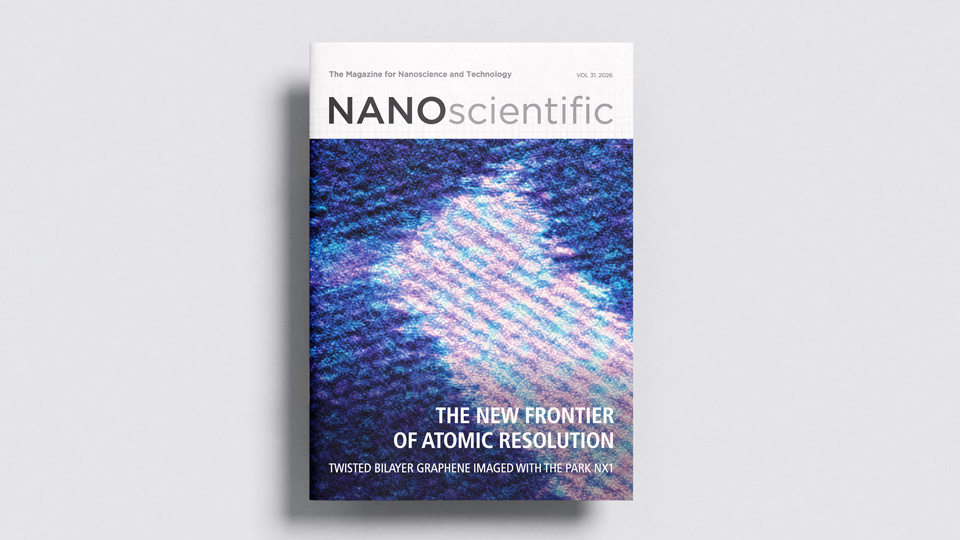
Park Systems has introduced the NX1, a new atomic force microscope (AFM) designed to deliver atomic-resolution imaging under ambient laboratory conditions. Developed in collaboration with Prof. Franz J. Giessibl of the University of Regensburg, the system transforms a research prototype into a commercial instrument, enabling a level of performance that has traditionally required ultra-high vacuum environments.
17 Sep 2026
Programs & Resources
Everything You Need to Advance Your Research
NANOscientific On-Demand
Access recorded presentations from all NSS symposiums, organized by topic.
Learn More →
Knowledge Center
Learn from AFM experts through online courses designed for convenient, practical learning.
Learn More →
AFM Scholarship
Empower the next generation of nanoscience researchers through scholarships and open scientific exchange.
Learn More →