Nanoscale Dynamic Mechanical Analysis with AFM at Sub-Zero Temperatures
- 18 May 2026
- Volume 30
- NANOscientific Magazine, 2026
Jake Kim, John Kim,
Park Systems Corp., Gwacheon, South Korea
Introduction
Dynamic Mechanical Analysis (DMA) is one of the most widely used techniques for characterizing the viscoelastic behavior of polymers and elastomers. By measuring the mechanical response of a material under oscillatory loading, DMA provides critical information about stiffness, damping, and molecular mobility. These properties play an essential role in determining the performance of polymer-based materials used in applications ranging from automotive tires and sealing components to electronic packaging and coatings.
Conventional DMA techniques, however, measure the response of relatively large sample volumes. As a result, the mechanical properties obtained represent averaged behavior across the entire specimen. For many modern materials—including polymer blends, nanocomposites, and thin films—this averaging can obscure important nanoscale variations that strongly influence macroscopic performance¹.
Atomic Force Microscopy based Dynamic Mechanical Analysis addresses this limitation by combining the spatial resolution of AFM with dynamic mechanical testing. Using an AFM probe to apply oscillatory forces directly to the surface of a material enables researchers to measure viscoelastic properties with nanometer-scale precision²˒³. This capability allows the investigation of localized mechanical responses within heterogeneous materials.
Temperature is another critical factor governing viscoelastic behavior. Many polymers undergo significant changes in mechanical response with temperature, particularly near the glass transition where materials shift from flexible, rubber-like states to rigid and brittle ones⁴⁻⁶. For applications exposed to cold environments—such as tires operating in winter conditions—understanding this temperature-dependent behavior is essential.
Recent advances in AFM instrumentation now allow dynamic mechanical measurements to be performed under controlled environmental conditions and at temperatures below 0 °C. The following examples illustrate how AFM-based DMA can provide nanoscale insight into polymer behavior while also enabling temperature-dependent measurements relevant to real-world applications.
AFM-Based Dynamic Mechanical Analysis
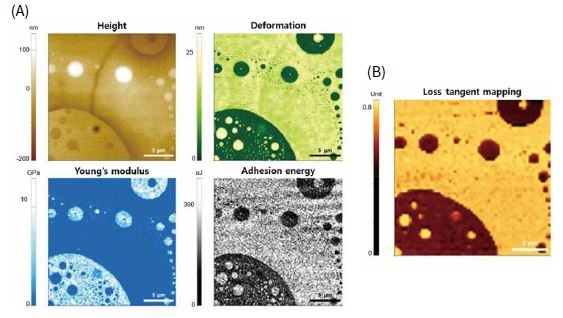
AFM-based DMA measures viscoelastic properties by applying a controlled oscillatory force through an AFM probe in contact with the sample surface. Unlike bulk DMA, which measures the response of the entire specimen, the AFM probe interacts with a localized region, enabling spatially resolved measurements of mechanical behavior.
During the experiment, a sharp AFM tip is brought into contact with the sample under a defined preload force. The probe is then oscillated across a range of modulation frequencies while the cantilever deflection and phase lag are recorded. From these measurements, key viscoelastic parameters can be extracted.
One important parameter is the loss tangent (tan δ), which describes the ratio of energy dissipated to energy stored during cyclic deformation. Materials with high loss tangent values exhibit greater damping and viscoelastic behavior, while materials with lower values behave more elastically.
An important advantage of AFM-based DMA is its compatibility with time–temperature superposition, a principle commonly used in polymer physics. Measurements collected at different temperatures can be shifted along the frequency axis and combined to generate a master curve. This master curve represents the material’s viscoelastic response across a much broader frequency range than can be directly measured. Such curves allow researchers to predict long-term mechanical behavior or high-frequency responses that may occur during real-world operation. The ability to construct master curves using nanoscale measurements provides a powerful bridge between localized material characterization and bulk mechanical performance.
Nanoscale Mapping of Polymer Blends
Polymer blends often exhibit complex microstructures consisting of multiple phases with distinct mechanical properties. Understanding how these phases interact at the nanoscale is critical for optimizing material performance.
To demonstrate the capabilities of AFM-based DMA, a blend of polystyrene (PS) and low-density polyethylene (LDPE) was investigated. This material forms a phase-separated structure in which PS domains are embedded within an LDPE matrix.
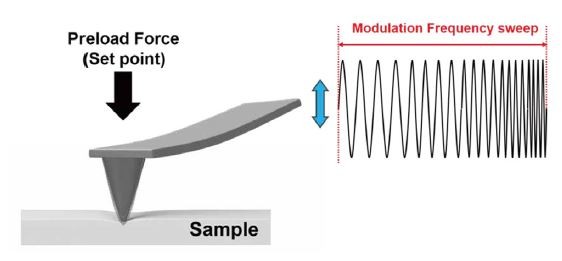
The same region of the sample surface was analyzed using two complementary AFM techniques: PinPoint nanomechanical mapping and AFM-based DMA. PinPoint mode provides quantitative mechanical maps including surface topography, deformation, Young’s modulus, and adhesion energy⁷˒⁸.
The topographic images revealed the phase-separated structure of the polymer blend. Polystyrene formed island-like domains dispersed throughout the continuous LDPE matrix.
Mechanical property mapping showed clear contrasts between the two materials. PS domains exhibited higher stiffness and lower deformation compared with LDPE regions, consistent with their known bulk mechanical behavior. Young’s modulus values for PS reached several gigapascals, whereas LDPE values remained below 1 GPa.
Adhesion measurements also revealed differences between the phases. LDPE regions showed stronger adhesive interactions with the probe, reflecting the greater chain mobility and flexibility of polyethylene compared with the more rigid polystyrene domains.
AFM-based DMA provided complementary information by mapping the viscoelastic response of the same region. The resulting loss tangent maps closely followed the morphological features observed in the mechanical measurements.
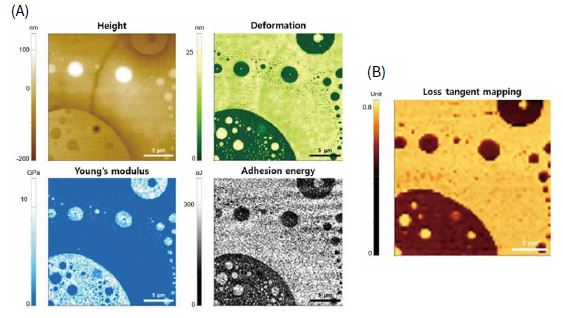
PS domains exhibited lower tan δ values, indicating predominantly elastic behavior with limited energy dissipation. In contrast, LDPE regions displayed significantly higher tan δ values, reflecting greater viscoelastic damping and molecular rearrangement during oscillatory deformation.
Together, the PinPoint nanomechanical maps and AFM-based DMA measurements provided a comprehensive picture of the nanoscale heterogeneity within the polymer blend. The combination of elastic and viscoelastic mapping clearly distinguished the properties of each phase and demonstrated how local material behavior can be directly visualized.
Temperature-Dependent Viscoelastic Behavior in SBR
While nanoscale mapping reveals structural heterogeneity, many polymer applications also require understanding how mechanical behavior changes with temperature.
Styrene–butadiene rubber (SBR) is widely used in applications such as tires, seals, and gaskets because of its flexibility and durability. However, its mechanical properties are strongly temperature dependent. As temperature decreases, SBR approaches its glass transition temperature (Tg) and gradually changes from a flexible rubber to a more rigid material⁹.
This transition has direct implications for applications such as winter tires, where maintaining flexibility and damping at low temperatures is essential for traction and safety.
To investigate this behavior, AFM-based DMA measurements were performed on SBR using a temperature control stage capable of regulating the sample temperature with high precision.
Experiments were conducted at five temperatures: –3 °C, 5 °C, 10 °C, 22 °C, 25 °C.
Maintaining stable experimental conditions during sub-zero measurements can be challenging because condensation can form on both the sample surface and the AFM probe. To avoid this problem, the AFM system was operated inside a controlled glovebox environment where oxygen and humidity levels were carefully regulated.
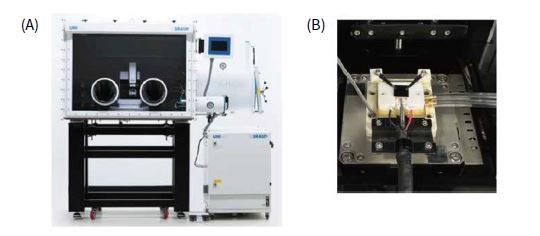
This combination of environmental control and temperature regulation enabled reliable nanoscale viscoelastic measurements at temperatures below freezing.
Loss tangent measurements collected at the different temperatures revealed clear changes in viscoelastic behavior as the material approached the glass transition. As temperature decreased, the response shifted toward higher stiffness and reduced molecular mobility.
By applying time–temperature superposition to the frequency sweep data, the individual curves obtained at different temperatures were combined to generate a continuous master curve spanning a wide frequency range.
This master curve extended the accessible range of viscoelastic characterization beyond the limits of direct measurement. Importantly, the AFM-derived master curve showed strong agreement with a reference master curve obtained using conventional bulk DMA at 20 °C.
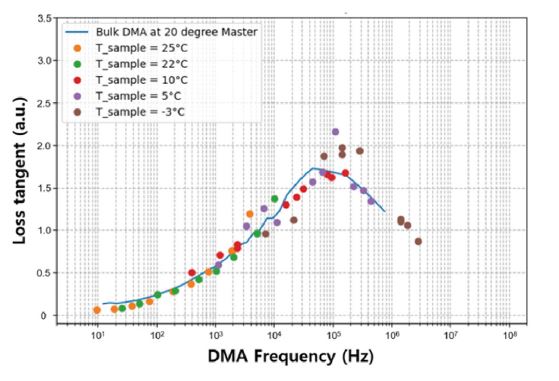
The close correspondence between nanoscale AFM measurements and bulk DMA results confirms the reliability of AFM-based DMA for evaluating viscoelastic behavior. At the same time, the AFM technique offers additional advantages by enabling spatially resolved measurements of mechanical properties.
This capability is particularly valuable when studying heterogeneous materials or interfaces where local variations in mechanical response may influence overall performance.
Linking Nanoscale Structure to Material Performance
The two examples presented here illustrate how AFM-based DMA can provide valuable insight into polymer mechanics at the nanoscale.
In the PS–LDPE blend, combining nanomechanical mapping with viscoelastic measurements enabled clear identification of domain-specific differences in stiffness, adhesion, and damping behavior. These measurements demonstrate how nanoscale characterization can reveal structural heterogeneity that may influence bulk material performance.
In the SBR study, AFM-based DMA measurements performed at sub-zero temperatures allowed the construction of a viscoelastic master curve consistent with conventional bulk DMA results. This capability enables researchers to investigate polymer behavior under environmental conditions relevant to real-world applications.
The integration of temperature control and environmental stability further expands the usefulness of AFM-based DMA for studying polymers and elastomers under extreme conditions.
Conclusions
AFM-based Dynamic Mechanical Analysis provides a powerful tool for probing viscoelastic properties with nanoscale resolution. By combining the spatial precision of AFM with dynamic mechanical testing, the technique allows researchers to investigate localized mechanical behavior within heterogeneous materials.
In polymer blends such as PS–LDPE, AFM-based DMA complements nanomechanical mapping by revealing domain-specific differences in viscoelastic response. In elastomer systems such as SBR, temperature-controlled AFM-based DMA enables detailed investigation of glass transition behavior and the construction of viscoelastic master curves.
Together, these capabilities allow researchers to connect nanoscale material structure with macroscopic mechanical performance. As polymer-based materials continue to evolve in complexity and functionality, techniques capable of probing localized behavior under realistic environmental conditions will play an increasingly important role in materials development.
AFM-based DMA represents a significant step toward achieving this goal, providing a bridge between nanoscale characterization and real-world material performance.
Acknowledgements
The authors gratefully acknowledge Professor Ken Nakajima and his research group at Tokyo Institute of Technology for their support and collaboration. Their guidance in selecting representative polymer samples (PS–LDPE and SBR), along with access to laboratory facilities for AFM-based DMA measurements, was essential to this work. Their contributions to data analysis and insightful feedback significantly enhanced the quality and clarity of this study.
References
- https://www.parksystems.com/en/products/research-afm/AFM-modes/Nanomechanical-Modes/dynamic-mechanical-analysis1
- Nakajima, K., Ito, M., Nguyen, H. K., & Liang, X. (2017). Nanomechanics of the rubber–filler interface. Rubber Chemistry and Technology, 90(2), 272-284.
- Nguyen, H. K., Liang, X., Ito, M., & Nakajima, K. (2018). Direct mapping of nanoscale viscoelastic dynamics at nanofiller/polymer interfaces. Macromolecules, 51(15), 6085-6091.
- Chartoff, R. P., Menczel, J. D., & Dillman, S. H. (2009). Dynamic mechanical analysis (DMA). Thermal analysis of polymers: fundamentals and applications, 387-495.
- Menard, K. P., & Menard, N. R. (2002). Dynamic mechanical analysis in the analysis of polymers and rubbers. Encyclopedia of polymer science and technology, 1-33.
- Deng, S., Hou, M., & Ye, L. (2007). Temperature-dependent elastic moduli of epoxies measured by DMA and their correlations to mechanical testing data. Polymer testing, 26(6), 803-813.
- https://www.parksystems.com/en/products/research-afm/AFM-modes/Nanomechanical-Modes/pinpoint--afm-nanoelectrical-modes
- https://youtu.be/z5F8-18of_I?si=bThIehyXR-GHMu71
- Chen, C., He, C., Bai, T., Hu, Z., & Fan, Z. (2025). Influence of Rubber Combinations on the Low‐Temperature Static Stiffness of Rubber Pad. Polymers for Advanced Technologies, 36(2), e70111.